Introduction: Can the Past Offer Solutions for the Future?
At a time when water scarcity, declining groundwater levels, and increasing pressure on natural resources have become serious challenges for many societies, revisiting historical approaches to water management has become more important than simply understanding the past. One remarkable example of this knowledge is the Iranian qanat, an underground structure that relied on an understanding of the earth, natural slopes, and water flow to provide access to water in many arid and semi-arid regions.
Scientific research on qanats shows that these systems are not merely achievements in the history of engineering. They also embody principles such as he use of natural energy, consideration of available water resources, and collective management—principles that remain relevant in contemporary discussions about water sustainability.
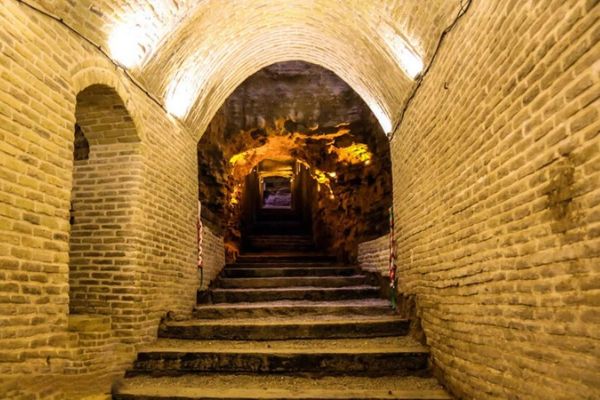
1. Engineering Without Electricity: How Did Qanats Transport Water?
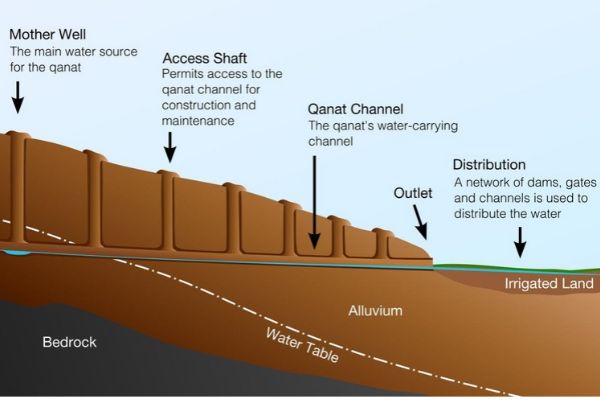
One of the most important features of a qanat is its use of gravity to transport water. In this system, water from an underground source at a higher elevation enters a gently sloping channel and flows towards the point of use without requiring a pump or fuel.
Constructing such a route required a detailed understanding of geological conditions, the location of underground water-bearing layers, and the calculation of the tunnel’s gradient. An excessive slope could result in unsuitable flow conditions, while an incorrectly designed route might prevent the water from reaching its destination. Therefore, building a qanat was not simply an excavation project; it was a form of engineering based on experience, observation, and the transmission of knowledge across generations.
This method of water transportation offered an important advantage: no external energy was required to move water along the channel. In addition, transporting water underground generally reduced direct evaporation compared with open channels, an important consideration in hot and dry climates.
2. Why can Qanats be considered as an example of sustainable watere
To understand the value of qanats, they must be examined within Iran’s climate context. In many parts of the central Iranian plateau, rainfall is limited and seasonal, and access to a permanent surface-water supply is not always possible. By gradually conveying groundwater to lower-lying areas, qanats made it possible for settlements, agricultural lands, and gardens to develop.
However, the significance of these systems extended beyond water transportation; it was also connected to how groundwater was accessed and used.
In a conventional qanat, water flows according to differences in elevation and the hydrological conditions of the source. The system does not require continuous pumping from deep underground to function. Research on qanat sustainability identifies this characteristic as one of their potential advantages, since pumping can lower groundwater levels and deplete underground resources when extraction exceeds natural recharge.
Nevertheless, this does not mean that qanats are always sustainable under all circumstances. If water extraction exceeds natural recharge, drought persists, or groundwater levels decline, a qanat’s flow may decrease or stop entirely. The sustainability of these systems depends on both natural conditions and the way they are managed.
3. How Does Today’s Water Crisis Differ from the Water Challenges of the Past?
Historically, communities in many arid regions depended on local water sources and mechanisms that limited extraction. In modern times, the expansion of deep wells equipped with pumps, increasing agricultural and urban demand, industrial development, and climate change have placed additional pressure on groundwater resources.
A study published in the scientific journal Groundwater in 2023 used historicalHistorically, communities in many arid regions depended on local water sources and mechanisms that limited extraction. In modern times, the expansion of deep wells equipped with pumps, increasing agricultural and urban demand, industrial development, and climate change have placed additional pressure on groundwater resources.
This finding demonstrates that today’s problem is not simply a lack of technology. Even a system that has operated in a region for centuries can become vulnerable to extraction beyond the capacity of available resources, environmental changes, and the erosion of local maintenance systems.
In other words, qanats remind us that access to more powerful technology does not necessarily mean better natural-resource management. If water extraction is not aligned with the rate at which resources are replenished, technology can increase pressure on those resources.
4. What Lessons Can Qanats Offer for Modern Water Management?
Examining Iranian and international research on qanats highlights several Examining Iranian and international research on qanats highlights several principles relevant to water-resource management and policymaking today.
- The Intelligent Use of Natural Energy
Qanat design demonstrates that an understanding of topography and the use of gravity can reduce the need for external energy in water transportation. This principle remains important in the design of sustainable infrastructure.
- Aligning Water Extraction with Available Resources
One of the most important lessons of qanats is their dependence on the natural conditions of groundwater aquifers. Modern water management must also align extraction levels with groundwater recharge rather than focusing solely on increasing the capacity to extract water.
- Collective Management and Shared Responsibility
Iranian qanats were managed through traditional systems of water allocation, maintenance, and cooperation among users. Research identifies these local institutions as an important part of the historical continuity of qanat systems.
- Protecting Infrastructure and Indigenous Knowledge
Preserving qanats involves more than repairing underground tunnels. Understanding water pathways, protecting aquifer recharge areas, and transferring specialized skills to future generations are also essential.
A study on qanat rehabilitation strategies published in the journal Water Research in 2024 emphasizes the importance of reforming water governance, providing financial support, and establishing effective institutions to restore these systems. Reviving qanats, therefore, is not merely a construction project; it also requires social, economic, and environmental planning.
5. Can Qanats solve Iran's crisis?
The scientific answer is positive, but conditional. In areas with suitable geological and hydrological conditions, qanats can continue to form part of a sustainable water-management strategy. Maintaining and restoring functioning qanats, protecting their recharge areas, and combining traditional knowledge with modern groundwater-monitoring tools may be beneficial in certain regions.
However, qanats are not a universal replacement for all water-supply infrastructure. These systems depend on suitable aquifers, sufficient differences in elevation, and reliable natural recharge, and their water output is subject to specific limitations. In areas where groundwater levels have fallen severely, simply repairing a tunnel cannot resolve the underlying water shortage.
The main lesson of qanats, therefore, is not that all modern technologies should be abandoned in favor of returning to the past. Rather, historical experience can help us select approaches that are more compatible with the capacity of the natural environment. Managing demand, improving consumption patterns, protecting groundwater resources, and appropriately using modern technologies alongside the preservation of traditional systems can create a more comprehensive approach.
Conclusion: A Heritage for the Future
Iranian qanats are an example of the connection between engineering, indigenous knowledge, and social cooperation. They demonstrate how past societies used their understanding of climatic limitations to develop systems suited to their environments, enabling settlements and agriculture to continue in many arid regions.
Iranian qanats are an example of the connection between engineering, indigenous knowledge, and social cooperation. They demonstrate how past societies used their understanding of climatic limitations to develop systems suited to their environments, enabling settlements and agriculture to continue in many arid regions.
Today, the value of qanats lies not only in their historical significance or their place on the UNESCO World Heritage List, but also in the opportunity they provide to reconsider the relationship between human beings and natural resources. Studying this heritage reminds us that sustainable water management is not merely a technical challenge. It also requires an understanding of nature’s capacity, collective responsibility, and long-term decision-making.
Qanats may not, on their own, provide an answer to today’s water crisis, but they can serve as one of our guides towards a more responsible future for water management.
Resources
-
Manuel, M., Lightfoot, D., & Fattahi, M. (2018). The sustainability of ancient water control techniques in Iran: An overview. Water History.
https://link.springer.com/article/10.1007/s12685-017-0200-7
-
Maghrebi, M. et al. (2023). Anthropogenic Decline of Ancient, Sustainable Water Systems: Qanats. Groundwater.
https://doi.org/10.1111/gwat.13248
-
Saatsaz, M., & Rezaei, A. (2023). The technology, management, and culture of water in ancient Iran from prehistoric times to the Islamic Golden Age. Humanities and Social Sciences Communications.
https://doi.org/10.1057/s41599-023-01617-x
-
Reviving the forgotten legacy: Strategies for reviving qanats as sustainable solutions for agricultural water supply in arid and semi-arid regions. Water Research (2024).
https://www.sciencedirect.com/science/article/pii/S0043135424010376
-
UNESCO World Heritage Centre. The Persian Qanat.
https://whc.unesco.org/en/list/1506/